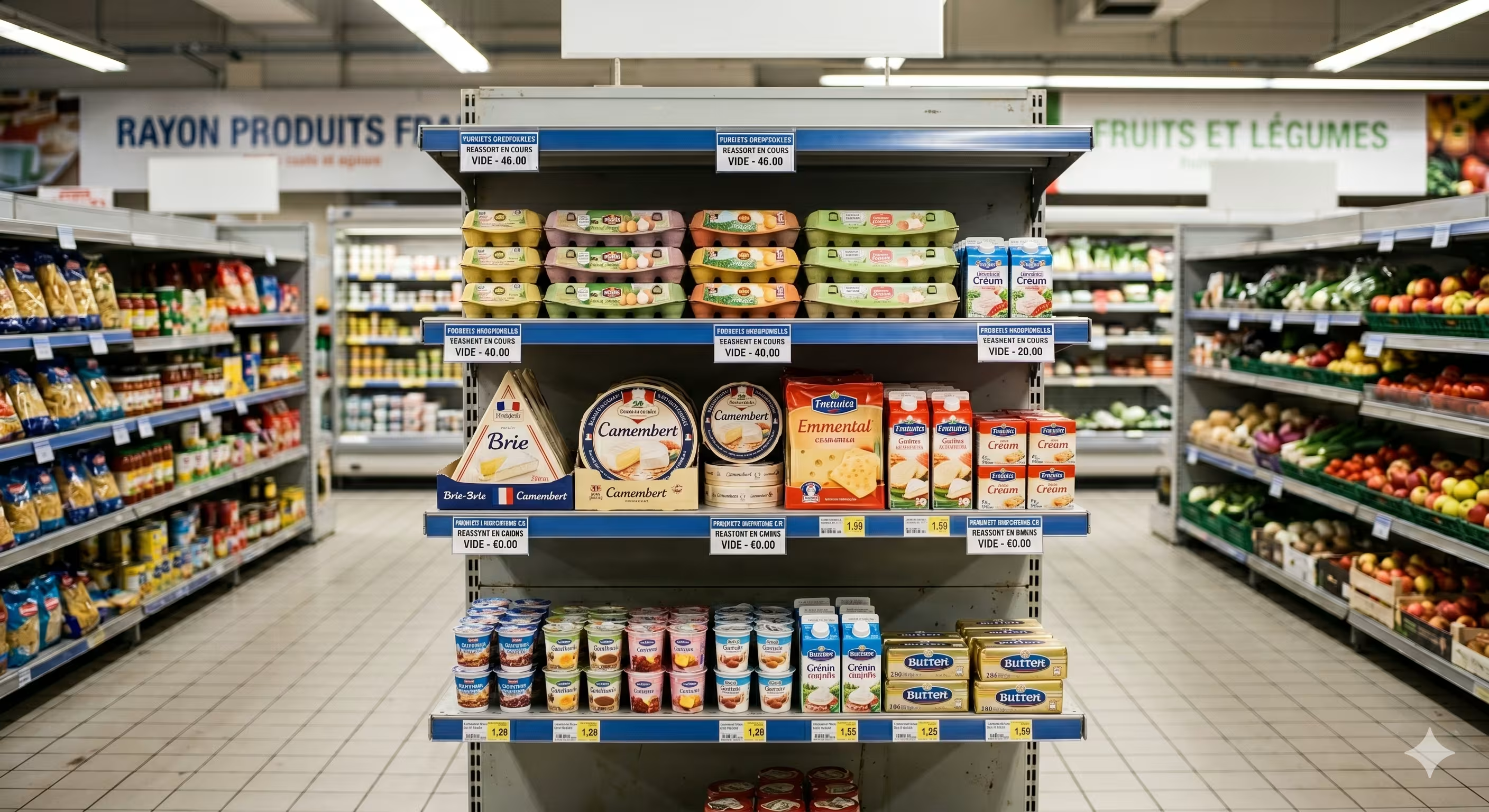
Price sensitivity in marketing: definition, measurement and uses in grocery retail

Valentine Dreyfuss
October 26, 2026
{{text-en-avant-1}}
At Mercio, we have been supporting retailers for 10 years, and one observation keeps coming up: a price increase does not have the same effect from one product to another. On some, it drives shoppers away; on others, it goes completely unnoticed.
According to the Simon-Kucher study on price image, reported by LSA in 2014, although 77% of French consumers say they always look for the best prices, 63% do not know a single exact price. As David Vidal, partner at Simon-Kucher, explains: "Ultimately, it is the basket that creates the price image, not an isolated product."
More recently, a Banque de France survey conducted in late 2025 among more than 4,000 households confirms this gap. Among households that have changed their shopping habits since the 2022-2023 inflation period, 92% say they pay closer attention to price changes. Yet on average, only 5% notice a price decrease when one has actually occurred.
In other words, customers do not perceive all price changes in the same way. They spot an increase on a product they buy often, and let many other movements slip by. For a retailer, the whole question is knowing which ones.
This is what marketers call price sensitivity. In this article, we explain what price sensitivity is, what influences it, how it is measured and, above all, how it is used in grocery retail.
What is consumer price sensitivity?
Before looking at how grocery retail uses price sensitivity, let's start by defining the terms.
A bit of history
Price sensitivity, whose measure (elasticity) was formalized by British economist Alfred Marshall in his book Principles of Economics, published in 1890, refers to the degree to which demand for a product changes when its price varies.
In practical terms:
- If a product is sensitive (high sensitivity), a small price increase causes sales to drop.
- If it is not very sensitive (low sensitivity), customers still buy the product even if its price rises, because the price carries little weight in their decision.
Price sensitivity is not a fixed characteristic: it can vary depending on the product, the customer, the location and the timing.
Take the (illustrative) example of a jar of Nutella and a jar of turmeric. The price of Nutella is well known and widely compared, while the price of turmeric is unknown to most shoppers. If a grocery retailer raises the price of a jar of Nutella by 5%, consumers may well notice and go buy it from a competitor, whereas the same increase will go unnoticed on turmeric.
Price sensitivity vs price elasticity: what is the difference?
Price sensitivity is a general concept that describes the behavior of the customer or shopper. Price elasticity, on the other hand, is the quantitative indicator used to measure it. The two concepts answer different questions:
- Sensitivity explains why a customer reacts to a price: they know it, they compare it from one retailer to another, they buy the product every week.
- Elasticity indicates the extent to which sales change when that price changes.
How is price elasticity calculated?
It is calculated using the formula below:
Price elasticity = % change in sales ÷ % change in price.
Within a defined analytical framework, elasticity is interpreted based on its absolute value: above 1, the product is generally considered elastic (sensitive), while below 1 it is inelastic (not very sensitive), although this threshold should be qualified depending on the competitive context and the time horizon.
Let's go back to the jar of turmeric: if its price rises by 5% and sales fall by 1%, we get:
Price elasticity = -1% ÷ 5% = -0.2
In absolute value: 0.2 < 1. The jar of turmeric is therefore inelastic (not very sensitive).
If the price of the jar of Nutella rises by 5% and sales fall by 10%, we get:
Price elasticity = -10% ÷ 5% = -2
In absolute value: 2 > 1. The jar of Nutella is therefore elastic (sensitive).

What factors influence price sensitivity in marketing?
Many factors influence price sensitivity.
Comparability
The easier it is to compare prices from one retailer to another, the more sensitive products are. National brands are easier to compare than private labels or exclusive items. This is why national brands are generally said to be more sensitive than private labels.
Role in the basket
Price sensitivity also depends on the role products play in the consumer's basket. For example, KVIs (Key Value Items, i.e. benchmark products whose price customers know) are highly sensitive. Conversely, long-tail items are not very sensitive.
Purchase frequency
How often products are bought also influences price sensitivity. We remember the price of products we buy every week, such as a jar of Nutella, milk or coffee, but not the price of an occasional purchase like a jar of turmeric.
Share of budget
The weight of a product in the budget is another factor that influences sensitivity. If a product accounts for a significant share of the budget or is bought in large volumes, it draws more of the consumer's attention; however, its actual sensitivity will also depend on the availability of substitutes and on its purchase frequency. This is the case, for example, with packs of diapers, which weigh heavily on young parents' budgets.
Availability of substitutes
If consumers can find a substitute for the product they usually buy, they will be more price sensitive, because they can easily switch. On the other hand, if the item they buy is unique, they will have to absorb price changes.
Local context
If a store is surrounded by discounters, it faces customers who pay closer attention to prices. The products it sells will therefore be more elastic. For example, the same jar of Nutella will be more sensitive in a supermarket next to two discounters than in a store that stands alone in its catchment area.
Economic context
During periods of inflation, consumer sensitivity increases across the entire basket. To preserve their purchasing power as much as possible, consumers compare the prices of everything they buy. According to an OpinionWay study for Bonial conducted in 2022, at the height of the inflation wave, 82% of French consumers changed their shopping behavior in response to rising prices, and 35% compare prices more often.
{{text-en-avant-2}}
How do you measure price sensitivity?
To refine pricing strategies in grocery retail, teams need to be able to measure price sensitivity. Below, we explain how to proceed using 3 possible methods.
1. Analyze sales data
Pricing teams can use the retailer's sales data to analyze price sensitivity.
This technique is based on real in-store behavior, so it stays close to the field. However, to be reliable, it requires isolating the variables that can affect sales volumes, such as promotions, seasonality, stock-outs or competitor price changes.
2. Test prices in stores
In-store tests allow you to create ideal scenarios to study your customers' price sensitivity, based on reliable data. The principle is simple: change the price in a few test stores and compare the results with similar control stores.
This approach gives you reliable results under real conditions, but it is time-consuming, complex to organize and impossible to roll out across thousands of items.
3. Run consumer studies (Van Westendorp method)
Another approach, called the Price Sensitivity Meter (PSM) and known as the Van Westendorp method, is used to find the acceptable price range for a product, i.e. the price customers are willing to pay. This model was presented in 1976 at the ESOMAR congress, the international association for market research.
To use it, you ask customers four questions about a given product:
- At what price would you consider it too expensive to buy?
- At what price would you consider it expensive, but still buy it?
- At what price would you consider it cheap, a good deal?
- Below what price would you consider it so cheap that you would doubt its quality?
By plotting the answers on a chart, you obtain an acceptable price range: between the price that is too low (which raises concerns) and the price that is too high (which drives customers away).
The limitation of this tool is that it relies on stated responses. And people do not always do what they say.

How AI helps assess sensitivity and improve your pricing strategy
All these measurement methods have their limitations and can make the task difficult for your pricing teams. AI takes over by classifying products according to their sensitivity levels, and by catchment area.
For example, it can reveal that a jar of Nutella is highly price sensitive in a store surrounded by discounters, and much less so in a store that stands alone in its catchment area.
It also works continuously, unlike studies that give you a snapshot at a given moment.
Finally, depending on the quality of the available data and the robustness of the chosen modeling method, it helps estimate and isolate certain confounding effects such as promotions, seasonality and competitor price changes.

Why is price sensitivity a key lever in grocery retail pricing strategies?
Lowering prices across all products can be costly in terms of margin, while raising them across the entire assortment can destroy your price image. Studying price sensitivity allows you to allocate your pricing effort: lower prices where customers compare, to protect your price image, and preserve your margin where they do not. This is what makes it a real lever for balancing margin and competitiveness.
Invest in price where customers compare
Highly sensitive products (such as the baguette, rotisserie chicken and Nutella) are the ones that can most influence your retailer's price image. An unfavorable gap on these products is enough to make a store look expensive.
Let's go back to the jar of Nutella: if it is priced 30% higher than at the neighboring retailer, customers may feel they are overpaying on their entire shopping trip and try another store the following week.
By taking this sensitivity into account, teams conclude that they need to invest in price on these products.
Preserve margin where customers do not compare
On the other hand, on products with low sensitivity, your retailer can afford a slight increase without losing volume. This margin will fund price decreases on sensitive products.
As a theoretical illustration (and subject to adjusting the assumptions to the actual structure of your fixed and variable costs), if your 200 long-tail items generate €1 million in revenue with a 25% gross margin rate, a 3% price increase leading to a volume drop limited to 0.6% (based on an elasticity of -0.2) generates an estimated theoretical gross gain of around €28,000 in additional margin.
This margin is enough to fund a 5% decrease on 20 KVIs (Key Value Items, the benchmark products whose price strongly influences a retailer's price image) representing €500,000 in revenue. Result: your price image improves on the products customers compare, without eroding your overall margin.
Once again, it is the study of price sensitivity that allows you to restore your margins where you can.
In summary: which pricing technique for which level of product sensitivity?
To recap, here is how to adapt your pricing strategy depending on whether a product is highly or not very sensitive.
Adapt your strategy by catchment area
The same product can be sensitive in one area and not in another, depending on the competitors present and the customer profile. Studying price sensitivity by area then allows you to adapt your strategy by catchment area. This is known as geo-pricing. You can read our dedicated article for more information on this topic.
Common mistakes when managing price sensitivity in marketing
To protect your retailer's pricing strategy, you need to manage price sensitivity while avoiding the most common mistakes. Make sure you:
- do not reason based on the national average, as it hides the gaps between stores. Geo-pricing is essential for precision in your pricing strategy;
- do not treat an entire product category the same way. Within the same aisle, the leading brand and the niche item do not react in the same way;
- do not treat price sensitivity as a fixed factor. It shifts with seasons, promotions and inflation;
- do not break the consistency of your range. For example, raising the price of a low-sensitivity private label can narrow the gap with the national brand and break the logic of the aisle.
{{text-en-avant-3}}
Valentine Dreyfuss
Valentine is the founder and CEO of Mercio. She has brought together the price-image challenges of retail heavyweights and the cutting-edge innovations of our engineering teams. Deeply committed to European technological sovereignty, she is Co-President of La French Tech in Düsseldorf, Germany, and passes on her knowledge to HEC students every year.
FAQ
How do you calculate price sensitivity in marketing?
To calculate price sensitivity, you use the price elasticity formula:
Price elasticity = % change in sales ÷ % change in price.
What is a price-sensitive product?
A price-sensitive product is a product that is:
- well known;
- comparable;
- bought often.
Which products are the least sensitive?
The least sensitive products are rare purchases, niche products, exclusive items and emergency purchases. For example, Destop, bought in a hurry to unclog a sink, or a jar of turmeric, whose price is unknown to most shoppers.