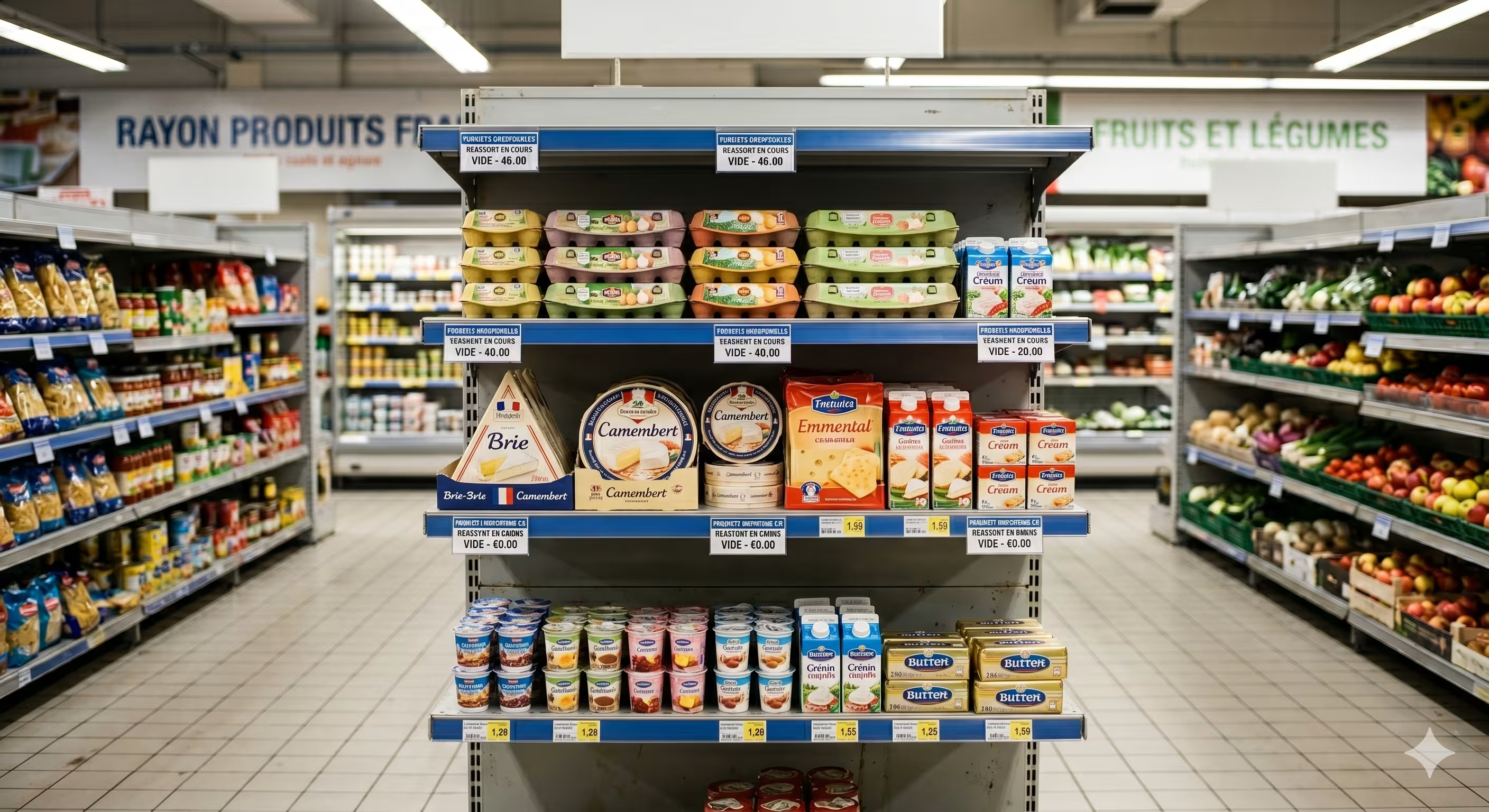
AI Agents and Dynamic Pricing: Rethinking How Grocery Retail Pricing Is Orchestrated

Valentine Dreyfuss
March 5, 2026
{{text-en-avant-1}}
Grocery retailers are facing mounting challenges. Inflation is no longer a short-term disruption but a structural reality. According to data from France’s national statistics office INSEE, consumer prices continue to show sustained growth.
At the same time, competitive pressure has intensified, and the day-to-day reality of pricing teams has become far more complex. Data volumes are exploding. Store-level personalization is expected. Market players are multiplying. Customers are increasingly price-aware and attentive to shelf labels. In this environment, traditional pricing strategies are reaching their limits.
Can technology and artificial intelligence provide the answer? AI agents combined with dynamic pricing are opening new possibilities. We are moving from isolated price optimization to full pricing orchestration.
In this article, we explore the limitations of traditional dynamic pricing approaches and explain how AI agents are reshaping pricing management in grocery retail.

Dynamic Pricing in Grocery Retail: What It Delivered and Where It Falls Short
Dynamic pricing tools have already been adopted by some retailers, particularly online pure players. Yet on their own, these tools have struggled to scale across the full complexity of grocery retail.
For years, pricing teams manually set prices product by product, often using Excel spreadsheets. This time-consuming process was gradually replaced online by dynamic pricing solutions. These tools significantly improved responsiveness to competitor moves.
When a competitor launched an aggressive promotion, teams could react more quickly. Price updates became more frequent because they could be implemented faster. This agility delivered early gains in both margin and competitiveness.
However, the promise of real-time dynamic pricing has rarely been fully realized in physical retail. Recent advances in artificial intelligence are changing the equation. Innovation is no longer limited to real-time price execution. It now strengthens operational excellence across established retail networks.

The Limits of Traditional Dynamic Pricing
While dynamic pricing has become standard in e-commerce, applying it to brick-and-mortar stores presents significant operational and psychological challenges.
Online, price changes are instant and largely invisible. In physical retail, displayed prices are legally binding and highly visible. Changing shelf prices during a store visit can create confusion and erode trust. Customers expect stability and transparency.
Traditional dynamic pricing systems also rely heavily on rule-based logic. For example, matching a competitor’s price decrease, respecting strict margin thresholds, or aligning with the lowest competitor.
These rules automate simple decisions but remain rigid. They do not independently adapt to shifting market conditions. They may ignore local context and sometimes contradict each other. A rule designed to protect competitiveness may erode margin. A rule designed to protect margin may prevent a necessary competitive response.
In the pursuit of speed, long-term pricing strategy coherence can be compromised. Teams still find themselves manually arbitrating trade-offs.
Even so-called dynamic systems often operate in silos. Pricing is managed separately from promotions. Assortment decisions follow different logic. Marketing runs independently. This fragmentation creates inconsistencies and weakens overall pricing performance.
Scaling is another challenge. Managing thousands of SKUs across hundreds of stores generates massive data volumes. Calculations slow down. Updates become less frequent. Decisions lose precision. The promise of responsiveness fades, and moving toward a truly global pricing strategy becomes difficult.

What Are AI Agents in Pricing?
AI agents are autonomous systems designed to achieve specific objectives. Unlike traditional tools that execute fixed rules, AI agents analyze their environment, interpret data and continuously adapt their actions.
In pricing, different agents address different dimensions of performance. Some monitor competitors. Others analyze demand. Others focus on margin optimization. Others protect price image and brand perception.
Instead of automatically matching a competitor’s price drop, a network of AI agents evaluates the full context. If the product is not highly price-sensitive and generates strong margin, the system may recommend a limited adjustment or no change at all.
If the product is highly competitive and strategically important for store traffic, the agents may recommend a stronger response, possibly tailored to specific stores or regions.
The result is targeted competitiveness where it creates value and margin protection where it does not.
AI agents collaborate. They share information. They coordinate decisions. This transforms dynamic pricing into a contextual and strategic system rather than a reactive one.
From Price Optimization to Pricing Orchestration
The real shift lies in orchestration. AI agents connect pricing, promotions and broader commercial strategy. Price decisions align automatically with promotional calendars, avoiding inconsistencies such as increasing prices just before a promotion.
They integrate strategic priorities. Traffic-driving products, new launches or end-of-life items are managed differently within the overall pricing strategy.
Most importantly, AI agents arbitrate between competing objectives. They balance competitiveness and margin protection. They prioritize volume or profitability depending on category dynamics. They adapt pricing decisions based on a product’s role within the basket.
This reduces manual intervention and aligns pricing, marketing and commercial teams around a unified strategy.
The Role of the AI Orchestrator
In a multi-agent system, AI acts as an orchestrator. Once business priorities are clearly defined, AI agents dynamically adjust product-level priorities according to market conditions. During inflationary periods, they may prioritize margin protection. During price wars, they may selectively reinforce competitiveness without sacrificing overall profitability.
They also manage potential conflicts between objectives automatically. They reconcile local flexibility with national consistency. They adapt pricing by store, region and channel while maintaining strategic alignment.
Pricing no longer needs to be manually adjusted at every level. The system continuously adapts based on traffic patterns, customer profiles and seasonality.
Continuous, Context-Aware Dynamic Pricing
Next-generation dynamic pricing is continuous and contextual. AI agents adjust prices at store level based on local performance. They differentiate between online and in-store pricing. They adapt pricing to demand peaks, such as weekday versus weekend consumption.
They also incorporate customer behavior, including purchase frequency and price sensitivity, to refine decisions.
This ensures pricing that feels fair and coherent while remaining fully aligned with business objectives and profitability goals.

Business Impact for Grocery Retailers
The value of AI agents goes far beyond operational efficiency. They enable retailers to :
- sustainably increase margin,
- strengthen price image,
- improve competitiveness,
- and reduce costly human errors.
{{text-en-avant-2}}
Key Considerations When Implementing AI Agents in Dynamic Pricing
Migrating from a traditional pricing tool to a dynamic pricing solution powered by AI agents requires careful attention to several critical factors.
First, data quality is essential. For AI agents to make accurate and relevant decisions, the data they rely on must be reliable, consistent and sufficiently robust. Poor data quality inevitably leads to flawed pricing decisions.
Second, transparency is non-negotiable. Decisions made by AI agents must be fully explainable so that business teams understand how prices are determined and retain control over the overall pricing strategy. While teams may no longer be involved in repetitive execution tasks, they remain the ultimate decision-makers. AI supports strategy, it does not replace it.
Finally, successful adoption depends on people. For a transition to an AI-powered pricing solution such as Mercio to succeed, in-store and operational teams must fully embrace the change. That is why, during deployment, our teams actively support change management and provide comprehensive training to ensure smooth adoption.
AI agents are far more than advanced assistants. They transform pricing into a fully orchestrated system. Instead of operating in a purely reactive mode, pricing becomes proactive, strategic and continuously optimized.
By simplifying operational complexity and strengthening margin performance, AI-driven dynamic pricing enables grocery retailers to improve profitability while reinforcing pricing as a central strategic asset.
{{text-en-avant-3}}
Valentine Dreyfuss
Valentine is the founder and CEO of Mercio. She has brought together the price-image challenges of retail heavyweights and the cutting-edge innovations of our engineering teams. Deeply committed to European technological sovereignty, she is Co-President of La French Tech in Düsseldorf, Germany, and passes on her knowledge to HEC students every year.